Showing posts with label literary bombs. Show all posts

Saturday, October 8, 2011

Book Review: Fascinating Womanhood by Helen Andelin

Title: Fascinating Womanhood
Author: Helen Andelin
Enjoyment Rating: 2/10
Referral: It's been on my reading list for years. Some of the girls in my fairy tales class were talking about it and I finally decided to read it.
Source: Ordered used (stinky and falling apart) from Amazon
Books I've read this year: 124

When I was an undergraduate at BYU, there were two books I heard a lot about, but I never read either one. The first was Betty Friedan's The Feminine Mystique and the other was Helen Andelin's Fascinating Womanhood. In my mind, both of the books were equivalent (I must have equated "mystique" and "fascinating")-- I knew that both had a reputation for being scandalous in some way, and that both had the power to change people's lives. Ha!

I read The Feminine Mystique when I was in grad school for the first time. I was working full-time, going to school part-time, and I had no kids. I thought the women portrayed in the book were total whiners-- after all, I would have given anything to be home with an adorable, angelic baby, devoting my life to my husband and my family, instead of working myself to the bone. I noticed that many of the women in the class, most of them mothers in their 40s and 50s, really loved the book, so I kept my eye-rolling to a minimum. A year later I had my first baby, and I totally got where Betty Friedan was coming from.

Over the years, I've heard more and more about Fascinating Womanhood, but I could never bring myself to read it. I felt like I'd already subjugated myself to my husband enough-- he went to med school, I went to work instead of starting a PhD program of my own. He started a residency, I had babies (which I desperately wanted, to be fair). He did a fellowship, I had more babies. Eventually I felt that all I was good at was having babies. So I didn't want Helen Andelin telling me I had to have babies and wear a dress while I cleaned the house, and put my husband in charge of all the money, and nod my head and smile while he made ridiculous financial decisions (which he doesn't, by the way, I take credit for any misinformed handling of money around here).

But I'm in a better place now. My kids are a little older, I've gained some confidence as a wife, a mother, and a person with a brain in her head. So I read the book, and it was just as bad as I thought it would be. Some of the interesting parts: Andelin's "good" examples of womanhood come from novels- and I'm convinced it's because the feminine ideal Andelin describes does not exist in real life. 90% of the information in this book is total crap and propaganda (letters from people whose lives were changed from reading it. 10% might be good advice (stuff like "find ways to compliment your husband"-- which I'm not very good at doing sometimes), but I find myself trying to discount the good advice because the bad advice is so very, very bad. I was talking to Eddie about the book, and we decided that it might be practical, last-ditch effort advice for a woman who really wants to stay married to a guy who is a total jerk and needs some help in figuring out how not to drive herself crazy, but for most people with healthy self-esteem, it sounds like a complete nightmare of a way to live.

Friday, April 1, 2011

Book #37: Finding Mercie (Whitney Book #16)

Finding MercieTitle: Finding Mercie
Author: Blaine Yorgason

Just a warning. This is not going to be nice. As honest as possible, but decidedly not nice.

If this book had been a paperback instead of a digital copy, I think I would have actually thrown it at the wall a few times. I was excited to see a book with LDS characters set in Chicago, and especially a novel with non-white LDS protagonists, so I had high hopes for Finding Mercie, but it was problematic for me on so many levels. When Hector Lopez finds a bleeding, frozen little girl on a Chicago street corner and rushes her to the hospital, the police initially suspect him, which forces them to examine his life a little more closely.

In Yorgason's defense, I think Hector's character is pretty interesting. He's charitable and spiritual to a fault, and that sometimes results in him having an inflexible world view. He's also very hard on himself. The other characters in the book, however, don't work as well. When the book opens, Hector's teenage son, Raul (literally a choir boy), and his girlfriend learn that they're expecting a baby. Both are good, active LDS kids who only slipped once. They had sex, and immediately (within a few hours) were in the bishop's office confessing their sin. Both of the teenagers go through a period of self-flagellation, and the girlfriend, in particular, has a lengthy passage where she basically compares herself to Bathsheba for not always being as modest in dress and attitude as she should be. There are times when I feel like passages from bad church slideshows from the 1970s have been dropped right into the book and this is one of them. Hector's girlfriend, Liliana, is also perplexingly inflexible. I have a hard time seeing Liliana and Hector having a successful marriage, despite what the angels say.

The book includes a lot of dreams and scenes where angels take care of Mercie (the girl Hector rescued). Call me a skeptic, but these scenes did not work for me. Hector seemed to base his life on these dreams, and even the police found themselves following the directives of the angels.

I think that the main problem of the book is that there were so many characters and storylines and some of them weren't wrapped up at all (how did Hector get his money? what is the prognosis of his illness? what's going to happen to the good-turned-bad-turned-good police officer? what's the deal with the dead teacher?) and others wrapped up a little too neatly. For example, there are 9 million people in the Chicago Metro area, but one bad guy was responsible for all the bad in the whole book. It felt completely unrealistic to have at least three different attacks perpetrated by the same baddie. It almost felt as if the bad acts were predetermined and predestined, because there was so much hokey spiritual stuff in the rest of the book.

Finally, while I admire Yorgason's attempt to capture the dialect of the Hispanic characters and the teen characters, both came off in a way that felt false and rubbed me the wrong way. And the village of Schamburg, which is an important location in the book, is consistently spelled wrong throughout. A good editor would have helped immensely on this project.

Wednesday, February 24, 2010

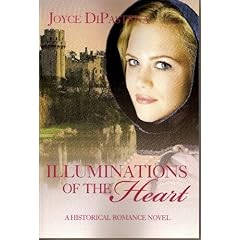
Book #20: Illuminations of the Heart (Whitney Book 3)

Title: Illuminations of the Heart
Author: Joyce diPastena

I feel like my review of this novel needs to come with a disclaimer: I do not read romance novels. I mean, I've read one or two in my life, but probably not in the last two decades. As a genre, they don't do it for me: they feel too predictable, too formulaic and too gag-inducing. And to be fair to Ms. diPastena's novel, this is the first of the five novels in the romance category that I read, so I don't have anything to compare it with.

Now that the disclaimer's out of the way, I'll just say it: I HATED this book. It was obvious at the end of the first chapter what the inevitable outcome of the book would be, but it took 425 pages for the protagonists to end up in one another's arms. And those 425 pages were so rambling, so full of unnecessary overdescriptions, so riddled with minute plot twists that kept the action moving forward at a snail's pace that I heaved (see, romance novel word!) an enormous sigh of relief when I finally finished the book and flung (ooh! another one!) it into my backpack.

So you want a summary? Siri ends up in 12th century France in the custody of Triston, a minor nobleman, after her whole family kicks the bucket in Italy. She's hot for Triston, and he's hot for her, but she looks uncannily like his dead wife, and half of the nobles in rural France have lined up to ravage her. So he has to protect her honor, and she has to make him fall in love with the woman she really is. Sounds terrible, doesn't it? I promise you, it is. I finished reading this book and wondered how it ever found a publisher, and, more importantly, how it found 13 people at Amazon to give it an average of 4.5 stars. But again, I'm not a romance reader. Maybe I'll be able to give a more accurate assessment once I've read all of the romances in the category. But I will be depressed as hell if this is the best of the bunch.

Sunday, January 3, 2010

Book #1: Cleaving

Title: Cleaving: A Story of Marriage, Meat and Obsession
Author: Julie Powell

Remember Julie Powell? Cute, sweet, Julie Powell so adorably portrayed by Amy Adams in the film Julie and Julia? Well, that Julie Powell and the one in Cleaving bear only a couple of resemblances: the hangdog husband Eric, and an annoying tendency to whine. In Bad Mother, Ayelet Waldman talks about how people with bipolar disorder make the best memoirists because they tend to overshare-- to lack the inhibition that makes most people stop talking about the most intimate details of their lives. While Julie Powell only hints at her psychological difficulties (quite possibly the only thing she only hints at), she definitely falls into the category of oversharing. Big time.

When I read on the book's jacket that she was caught between her faithful husband and a lover, I thought the lover must have been a lover in a metaphorical sense. But no, Cleaving is the story of how Powell makes herself miserable over the course of the three or four years after the end of Julie and Julia, carrying on an extended affair with the man she cheated on Eric with back in college, a man who indulges her S&M fantasies (yes, I'm serious). While the personal stories are squirm-worthy and almost too salacious to be believed, she mixes them in with the story of her butchering apprenticeship, which I actually sort of loved. I learned a lot about how meat goes from squealing to sausage, and I think she did a pretty good job of using metaphors between butchering pigs and cows and the butchering she was doing to her marriage.

You've got to admire someone who isn't afraid to come across as pretty despicable, as Julie does in Cleaving. But honestly, I was riveted. I could not stop reading the book. But if it had been my life (which I cannot even fathom), I would have changed the names and the places and called the thing a novel.

Friday, September 25, 2009

Book #54: The Saucier's Apprentice

Title: The Saucier's Apprentice: One Long Strange Trip Through the Great Cooking Schools of Europe
Author: Bob Spitz

I love to cook. I also have a family of picky young children, genetically influenced by their picky father. Day-to-day cooking is much more of a chore than an expression of creativity. But I still love to read books about food and cooking-- but not this one. To tell you the truth, Bob Spitz's memoir depressed me. He writes about having a midlife crisis-- finishing a big book, getting divorced, and losing his moorings. So instead of buying a sports car or hooking up with a floozy, he somehow scored an expenses-paid trip through the cooking schools of Europe, where he learned to make perfect omelets, pack in course after course of Neapolitan specialties, brown-nose chefs, and turn up his (now brown) nose at the rich American housewives who ended up being his classmates. According to Spitz's exacting standards (only made more exacting on the course of his journey), my attempts to feed my family would be deemed pathetic. Sometimes, however, food is just about family and sustenance. And that's enough.

Saturday, September 5, 2009

Book #50: The Grift

Title: The Grift
Author: Debra Ginsberg

I'd love to read a little bit about how book covers are designed, because I picked up The Grift on the basis of its cover (I like the font and the dotted border and the way the "r" is dropped down from the rest of the word) and its location on one of the tables at the front of the library. When I got home, I saw that it had 4 1/2 stars on Amazon, so I packed it in the bag I brought to the hospital, and it kept me occupied while Isaac and I sat around at PCMC.

Occupied, but not exactly entertained. The book started out promisingly, the story of a fortune teller who leaves Florida for California to start a new life. She becomes entwined in the lives of a few stock-character clients along the way, which isn't great, but still fine. And then she meets a man, falls in love, and goes absolutely CRAZY. Up to that point in her life, she'd been a sham fortune teller, more of an amateur psychologist than anything else, but after a personal tragedy she finds herself with a real clairvoyant gift, and it changes her life. And the book gets very weird. And not very good.

Unless you're better than I am at suspending disbelief, don't judge this book by its cover or its Amazon reviews and stay away.

Wednesday, January 7, 2009

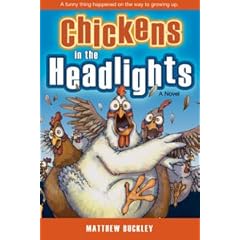
Book #2: Chickens in the Headlights

Title: Chickens in the Headlights
Author: Matthew Buckley

My brother and sister-in-law sent this book our way for Christmas. It's the story of a summer in a house full of seven boys ages nine and under. I think Bryce would really like it, but I'm not sure I should let him read it-- he might get some ideas. As for me, it made me really glad that I didn't grow up with seven brothers and that I don't have seven boys of my own. The two I do have do a perfectly adequate job of making me happily crazy!

Monday, December 8, 2008

Book #82: Salem Falls

Title: Salem Falls
Author: Jodi Picoult

I wasted most of this weekend reading Salem Falls, the story of Jack, a high school history teacher who tries to start his life again after being wrongly accused of sexual assault, only to have the whole thing happen again in the new town. It was an easy read, an engrossing story, but there were parts of the story that drove me crazy. For one thing-- the dates were constantly off. For example, Jack's love interest Addie had a daughter who died some time in the past. At one point, they said she'd died ten years earlier, at another point, they said it was eleven years earlier, and another time they said it was eight years earlier. It might not seem like that big a deal, but it mattered to me, because it was the only way for me to gauge how old Addie was, since I knew that she was twenty-seven when her daughter died (or was she?). At the end of the book, they talk about how Jack went to jail in the summer of 1998, but the book takes place in 2000, and he was in jail for eight months, so he obviously went to jail in 1999. It's stuff like that that drove me nuts. Furthermore, while the story kept me reading, it felt like literary McDonalds. Not really good, not at all mind-expanding, but it somehow kept me coming back for more. It definitely cemented my opinion that Jodi Picoult is the female gender's John Grisham.

Sunday, August 10, 2008

Book #53: The Fig Eater


Title: The Fig Eater
Author: Jody Shields

A woman (based on Dora, a patient of Sigmund Freud) is found murdered in a Vienna park and a police inspector and his wife use two very different methods (scientific and intuitive) to race to solve the crime.

My sister had this book several years ago and I loved the cover and wanted to read it. A few weeks ago I bought my own copy and set to reading it. I noticed that it only had two and a half stars from amazon, but was undaunted-- it was exactly the kind of book that I would like. But it was seriously one of the worst books I've ever read. It was SO boring, painful, in fact, to plug through. I think the main problem was the characterizations. I just didn't care at all about the inspector and his wife. They never even gave the inspector as a name, so it made it hard to feel connected with him. And their relationship? So weird. This was a horrible book, although it has a good cover.

Monday, April 28, 2008

Book #32: The Appeal


Title: The Appeal
Author: John Grisham

A big nasty corporate raider pays to have a conservative, good-looking, stuffed shirt elected to the Mississippi Supreme Court to avoid paying damages for the people his company's pollution killed.

This book was so terrible, that I must have blanked out the fact that I did, in fact, finish it.

Monday, December 10, 2007

Book #65: The Alchemist


Title: The Alchemist
Author: Paulo Coelho

I'll admit that I suppressed a groan when my book group selected The Alchemist to put on our reading list this year. I generally hate "spiritual" books. I particularly can't stand anything written by Mitch Albom (Tuesdays with Morrie wasn't terrible, but everything else I've read has been positively gag-worthy). I also knew that a lot of readers compared The Alchemist with St. Exupery's The Little Prince, which I also hated. And believe me, it wasn't just because I was struggling with my French because I hated it just as much when I read it in English.

With those incredibly low expectations in mind, I have to say that the book wasn't as terrible as I thought it would be. I'll liken it to eating dinner at Applebees. In my mind, I hate Applebees. Applebees represents all that is bad about cheapy chain restaurants with bad microwaved food. But a year or so ago I had dinner at Applebees and it wasn't awful. It wasn't great, but it wasn't awful.

And so it was with The Alchemist. It's a fable about a boy who dreams about finding a treasure, follows his heart, and takes a circuitous journey to reach his treasure. The main point of the book is that we can all accomplish great things if we follow the inner promptings of our heart and stay true to the desires within us. I think that for someone who is as unattached as a sixteen-year-old shepherd, that's probably true. But as a 32-year-old mom with a house and four kids and a husband, I sometimes need to temper my dreams. So I'll give Coelho points for inspiration, but not for practicality.

Sunday, September 9, 2007

Book #47: Fatal Distraction: Or How I Conquered My Addiction to Celebrities and Got a Life


Title: Fatal Distraction: Or How I Conquered My Addiction to Celebrities and Got a Life
Author: Emmi Fredericks
Just don't even bother reading it. I'm so embarrassed because the first twenty pages or so weren't awful, so I recommended it to a friend who shares my addiction to Star magazine and Entertainment Weekly. But after the first twenty pages, it takes a serious nosedive. The protagonist, Eliza, doesn't have a life because she's obsessed with celebrities. And apparently, it's not too easy to write a book about someone who doesn't have much of a life. In fact, the book was so bad that when Sunday came around (my one nod to the sabbath day is that I won't read trashy magazines) I set the book aside, 2/3 read, and on Monday, I couldn't bring myself to finish it. Maybe Eliza dumped her boring, awful friends and got herself a life, but I just don't care.

Sunday, August 5, 2007

Book #32: My Sister's Keeper

My Sister's Keeper : A Novel


Title: My Sister's Keeper


Author: Jodi Picoult


This week in Newsweek, there's an article about "helicopter" parents, aka parents who hover over their children. Lydia Meadows, in A Most Uncommon Degree of Popularity definitely qualifies as a helicopter parent, fussing over every slumber party invitation and school essay. But I'd also say that Sara Fitzgerald in My Sister's Keeper hovers to a degree that makes her children uncomfortable.


Of course, Sara has more justification for her hovering than Lydia does. Sara's daughter, Kate, who is sixteen when the novel opens, has been fighting APL, a particularly deadly form of leukemia, for fourteen years (most people with this type of leukemia live about a year after diagnosis). When Kate is diagnosed, keeping her alive becomes the driving ambition of Sara's life. A year after the diagnosis, Sara gives birth to Anna, conceived through IVF to be a donor-match for her older sister. Over the next thirteen years, Anna donates cord blood, regular blood, leukocyctes, bone marrow and other things I don't remember. When it becomes evident that Kate will only surive if she gets a new kidney, Sara automatically expects Anna to give up her spare. The only problem? Anna doesn't want to.


My Sister's Keeper raises all sorts of interesting issues for parents. When the best course of action for one child is the worst course of action for your other child, what do you do? Is it possible to work too hard to keep a child alive? What happens when one child is sick and the other two get lost in the shuffle? It's a hard book to read from a parent's perspective, an interesting read from a medical perspective, and all in all, an engrossing, quick read.


--originally published 5/21/06

Book #31: A Most Uncommon Degree of Popularity

A Most Uncommon Degree of Popularity


Title: A Most Uncommon Degree of Popularity


Author: Kathleen Gilles Seidel


Erin Meadows is a sixth-grader at Alden School in Washington, DC when she suddenly finds herself one of the popular girls. Just as suddenly, she's jetted from the "in crowd" when a conniving queen bee weasels her way in. For most preteens, this dilemma would be enough of a crisis, but Erin has another problem: her mother, Lydia, seems to have absolutely no life at all outside of Alden and the social networks of the school.


At first, I thought I'd like this book. It was compared to Jane Austen, called a modern "comedy of manners" and had glowing reviews on the back. But it was lame. If I were Lydia Meadows, I'd be so embarrased that I had traded my day job as a lawyer in order to orchestrate class teas and coordinate carpools. I mean, I'm involved in my kids lives; I drive carpools, try to get them in the schools that would be right for them and obsess (on a minor level) over their extracurricular activities. But Lydia seemed to have no life outside of being a soccer mom or fretting over getting the kids into Sidwell Friends or worrying over whether or not her daughter will win back her friends. She actually says at one point in the novel that she loves soccer games because she loves the time she spends getting everything packed (liked the orange slices) and neatly arranged in the trunk of her station wagon. I, for one, hate soccer games. I hate feeling torn between watching the kid who is playing and keeping the other kids entertained, hate lugging the camp chairs to the side of the field, hate worrying if my kid is going to decide to pick flowers during an important play. And orange slices? Forget about it. My kid is lucky to have a juice box and a baggie of goldfish waiting for him on the sidelines.


Anyway, I had a hard time relating. I also though that reading the book might help me understand my godmother better. She has one daughter (now in college) who attended a private school that sounds pretty similar to Alden. And like Lydia, Annie threw herself into that school, organizing teas, running the concession stand at ball games, hosting pre-prom dinners at her house, etc... And when Beth went to college two years ago, I think it was really hard for Annie not to have the ties to Beth's school anymore. But reading this book didn't help me understand Annie, at least not in any way that makes me more sympathetic.


So if you see A Most Uncommon Degree of Popularity on the clearance table at Barnes and Noble, feel free to pass it by.


-originally published 5/19/06