Showing posts with label food. Show all posts

Friday, December 5, 2014

Book Review: The Tastemakers by David Sax

Title: The Tastemakers: Why We're Crazy for Cupcakes but Fed Up with Fondue
Author: David Sax
Enjoyment Rating: ***
Source: Kindle

I heard David Sax on talking about his new book, The Tastemakers, on RadioWest a month or so ago. I was out walking the kids and the dog, and I was so captivated by the conversation that I came right home, bought the book and started reading. If you've been reading my blog for a while, you know that I love this kind of stuff-- where food intersects with pop culture. In The Tastemakers, Sax explores food trends-- what makes a trend grow big (basically, put it on an influential television show or launch it in NYC), how future trends can be predicted, why some trends make it while others don't, and where good food trends go to die (The Melting Pot, apparently).

Sax does a nice job educating his reader while being entertaining, Part journalist, part memoirist, Sax goes to apple orchards in Canada (what will replace the Honeycrisp as the darling apple of the next decade?), to Baconfest, and to Dole with a group of food bloggers. However, there wasn't a lot I felt like I learned about food trends from the story, beyond what Sax and Doug Fabrizio talked about during the hour-long show. Still, this is an entertaining, quick read, and good for anyone who wants to know why the heck we're all eating kale chips and chia seeds right now.

Sunday, May 19, 2013

Book Review: Cooked by Michael Pollan

Title: Cooked: A Natural History of Transformation
Author: Michael Pollan
Enjoyment Rating: ***
Source: Personal Copy

A few nights ago, Michael Pollan was here in Salt Lake. We weren't going, of course, because I don't do anything at night these days that doesn't involve lying on Eli's floor while he falls asleep, but I couldn't help fantasizing about what he would say if he showed up on our doorstep for dinner. We were eating taco salad, and as I got dinner ready, a commentary of what he would say kept running through my mind:

Lettuce (iceberg, ick-- no nutritional value and it's not organic)
Tomatoes (hothouse, or from Chile. Either way, your carbon footprint is too big)
Chili (meat from a factory farm)
Shredded Cheddar (cows were fed antibiotics, no flavor profile to speak of)
Guacamole (why did you use a seasoning packet instead of onion, limes, garlic and your own spices? That's not real cooking)
Salsa (Pace-- how lowbrow)
Tortillas (white flour, lots of preservatives)
Doritos (do you seriously expect me to eat this?)

The thing is that I really, really want to like Michael Pollan. I want to like Cooked. I want to be a devotee who bakes her own bread and uses up her CSA veggies every week. I want to feed my children healthy food and pay attention to things like how meat is raised and where my food comes from.

And for the first few weeks after I read a book like this, I can usually get into the spirit of things. But in Cooked, Pollan writes about how the amount of time people spend on preparing food has decreased, and I firmly believe that in order to feed my family in a Pollan-esque way, I would have to spend as much time thinking and working at it, and as much of our family income paying for it, as the hunter-gathers did. It would have to be my passion, and while I can feel passionate about baking a birthday cake or a killer pan of brownies, putting dinner on the table every night just doesn't get my juices flowing.

In Cooked, Pollan explores four different cooking methods. And he does it like a man. He even picks manly subjects like barbecue and beermaking. What I mean by "he does it like a man" is that he is able to explore these subjects like an ardent hobbyist, not like someone who has to put food on the table 21 times a week. He's making things like whole hogs and braises that take days to prepare, food where everyone will bow down and worship him when he sets it on the table (because he is, after all, a man who is cooking. When my husband makes rice and throws a little curry in it, we all act like he could get hired by Bobby Flay).

I understand the importance of cooking, but this book does little to communicate the everydayness of cooking. When Pollan wants to learn about bread, he bakes with the guy who just wrote a cookbook. When he wants to learn barbecue, he works with a pitmaster with a James Beard award. He is Michael Pollan, after all. But he doesn't seem to realize that the opportunities he has when he decides he wants to be a cook are not what most people have. What I'd love to see is how Pollan would feed my family-- six kids, one of whom eats only a dozen things, all running every which way after school, while also driving those six kids to the places they need to go. There's a scene in the book in which Pollan and his son visit one of the evil "middle aisles" of the grocery store (the freezer aisle, to be exact) and buy frozen dinners. Pollan buys an Amy's, which already feels a little out of touch with the 98%. Then they cook them and eat them, while he analyzes the nutritional qualities of each (and denigrates the microwave). I wonder how long Pollan would hold out against the microwave and the chicken nuggets if faced with my brood.

Defensive much? I guess so, but the book touched a nerve. I feel like it told me all the hundreds of ways that my kitchen (and therefore my children) were on the wrong track, but not much practical advice on how to fix it.

Friday, February 1, 2013

Book Review: The Smitten Kitchen by Deb Perelman

Title: The Smitten Kitchen
Author: Deb Perelman
Enjoyment Rating: ***
Source: Personal Copy

I am not one of Deb Perelman's regular readers. In fact, although I used to read lots of food and design blogs, I quit reading both when I started grad school and haven't picked up the habit again now that I've returned to the indulged and privileged role of the SAHM. But really, I think food blogs and I were on the outs before then-- I'd look at the blogs and get all excited and then turn away from the computer to the realities of my kitchen and feel depressed.

I used to be a good cook. When I got married, I had a cookbook shower. I've subscribed to Cooking Light for years (although I don't really read the recipes). I adore baking. But that's because my kids will eat the food I bake. In fact, the book came on my radar when I was looking for a recipe for rice krispie treats that don't taste like cardboard (and she delivered). But dinner? If at least half of them are going to turn up their noses at the food (including the one who eats four things), then it feels like too much work. We have late afternoon activities every dang day. I hardly ever know when Ed is going to be home until he calls and says he's on his way. And now I have a toddler (soon to be TWO toddlers) who is at my knees when I make dinner.

See all of those excuses? Deb Perelman made me reconsider each one. Her book is gorgeous-- beautiful, simple photography of food made in her closet, which is approximately the size of my pantry. If she can cook this kind of food in there, I certainly don't have excuses related to the size or functionality of my kitchen. I know bloggers thrive on enthusiasm and hyperbole, and this often bugs me, but I think the book hit me at a time in my life where I can be prodded back into the kitchen with a little cheerleading.

I read every story in the book, dropped it in the snow to christen it, then let Rose run around on its pages to make it look well worn, but I still hadn't cooked anything from it, and therefore wouldn't let myself review it. But this morning Rose and I baked brownie cookies and granola (where I substituted chocolate covered dried cherries for the dried cherries and just about swooned when I sat down to a bowl or three for lunch). So yeah, she's legit. It's not just the stories and the photography, the food rocks too.

I'm taking baby steps back to the kitchen. If there are foods I can start in the morning, that works best for everyone in the family (especially me-- it saves me from being truly harried on the 14 drives to and from the dance studio each week) and there are plenty of recipes in the book that would allow me to prep/marinate/slow cook early in the day. Maybe the kids will expand their palates. Maybe I will forget the phone numbers to all the takeout places within a two-mile radius (which makes dinner so easy). Who knows? Maybe we'll even start having people over for dinner again.

Wednesday, December 12, 2012

Book Review: Back to Blood by Tom Wolfe

Title: Back to Blood
Author: Tom Wolfe
Enjoyment Rating: **** (although I am embarrassed to admit this)
This book would be rated: NC-17 or X for extremely graphic sex scenes
Source: Audible for iTunes
Books I've read this year: 123

A few days ago I was reading the newspaper and saw that Tom Wolfe's novel Back to Blood had been nominated for a "worst sex in fiction" award and I laughed out loud. I'd just finished reading Back to Blood and I was having a hard time sorting out in my mind if Wolfe was a genius or just a dirty old man. I will say this-- I did a LOT of fast-forwarding through this book.

Back to Blood takes place in Miami. Maybe that says it all. Wolfe says that "New York is the city of money. Washington D.C. is the city of power. Miami is the city of sex," so it shouldn't come as a surprise that everyone thinks below the belt in Back to Blood, a story populated with (hot) Russian oligarchs, (hot) Cuban police officers and nurses, and (hot) Haitian college students. The main characters, Magdalena and Hector, start the book as a couple, but Magdalena dumps Hector for the (hot) white doctor she works for. As Magdalena and Hector grow apart, the new situations they find themselves in have a way of working to bring them back together, under much different circumstances. The book deals with power, corruption, race relations, and lots, and lots, and lots of sex.

One thing that I really enjoyed about the book is that Wolfe creates two main characters who are both deeply flawed, but also sympathetic. I wanted Hector and Magdalena to gain a bit of self-mastery, but also to find success and happiness in Miami.

Sunday, July 22, 2012

Book Review: Extra Virginity by Tom Mueller

Title: Extra Virginity: The Sublime and Scandalous World of Olive Oil
Author: Tom Mueller
Enjoyment Rating: ** (2 1/2?)
Source: Audible for iTunes
Books I've read this year: 87

I used to read a lot of books about food. I used to cook a lot. I used to take cooking classes. I used to consider myself a foodie.

These days, I cook as little as humanly possible. Can a family of seven live on cheese quesadillas and diet coke? I think we're the test-case family. Somewhere between kid three and four, when I realized that kid one would only eat five things for the rest of his life and Ed really didn't care what we ate for dinner, I gave up. Sure, I still buy the cookbooks and thumb through them. I hide in the bathroom with Cooking Light every month and salivate over foods I'm not going to make. Then I come back to the kitchen and whip up a batch of spaghetti with butter and parmesan cheese for dinner, with bread on the side for Bryce, who doesn't eat spaghetti. I'm mostly okay with it, at least until my mom visits and I decide I have to cook every once in a while, just to save face.

So how did I end up with Extra Virginity in my Audible queue? I'm not sure. I think it must have been a 2-for-1 sale. What did I gain from reading the book? A gigantic sense of inadequacy-- I can't tell a peppery oil from a mild one, and I'm pretty sure that the oil in my cupboard would be considered "lampante" oil not really fit for human consumption by oil connoisseurs. Mueller explores the history of olive oil, back to the birthplace of civilization, through biblical times, through the Middle Ages and Renaissance and into the modern era. He interviews dozens of (to me, indistinguishable) oil producers, and looks at the problems of living as an olive oil farmer, the scandals within the industry, and the benefits of using high quality oils.

I almost quit this book several times in the first half. It seemed pretty repetitive, and I felt that I was going to be preached to the entire time. And my assumptions were pretty much spot on. But I found that once I put the book on 1 1/2 speed, the book became much more entertaining. It almost convinced me to visit the local olive oil store, which is just down the street. Maybe. When my huge bottle of lampante is gone.

Wednesday, February 1, 2012

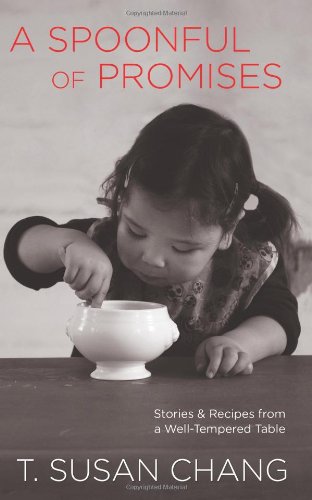
Book Review: A Spoonful of Promises by T. Susan Chang

Title: A Spoonful of Promises: Stories and Recipes from a Well-Tempered Table
Author: T. Susan Chang
Enjoyment Rating: 8/10
Referral: I got this book for my birthday from my godmother, Annie
Source: Hardback
Books I've read this year: 8

For several years, I went through a foodie phase where I read lots and lots of memoirs about food. Then I started grad school and my kids were lucky to get one home-cooked meal each week that wasn't pasta, grilled cheese, quesadillas or chicken nuggets, and I felt like a poseur reading all of the foodie books. But (thesis notwithstanding) the grad-school phase is done, and maybe this book represents a return to the foodie memoir, a genre I really love.

I've heard of Susan Chang before. I remember reading one of her articles a few months ago about the crazy kinds of ice cream she makes with her family and it felt kind of braggy-- her kids clamor for basil ice cream, really? I'm lucky if mine venture beyond Creamies. So I was expecting bragginess from the memoir as well. And yeah, it does venture in that direction at times, but overall, I really liked the format. She'd tell a story about a food and provide a recipe. The recipes/stories were roughly grouped together into categories (easy dinners or crazy meals, for example) and over the course of all of the stories, cohesive themes began to emerge-- her love for her dad, her relationship with her husband and kids, the sense of loss she feels from her mom's death when she was a teenager. It's a format that I could see working well for my mom, for instance, if she chose to write the story of her life. I'm not sure that it has inspired me to go out and make beef heart chili (or at least not to serve it to my kids), but I may try the Pad Thai.

And since my radar is attuned to all things Chinese American these days, I was also interested in the ways that Chang incorporates her Chinese American background into the story. I know that our daughter will undoubtedly grow up more American than Chinese, and I was grateful that Chang let us glimpse into her childhood as a third-generation Chinese American, a girl whose mom stuffed her lunch not with dumplings and rice, but with wheat germ and granola bars.

Thursday, September 29, 2011

Book Review: Blood, Bones and Butter by Gabrielle Hamilton

Title: Blood, Bones and Butter: The Inadvertent Education of a Reluctant Chef
Author: Gabrielle Hamilton
Enjoyment Rating: 7/10
Source: Kindle for iPad
Referral: A lady sitting in front of me in an endless Suzuki viola group lesson was reading it, so I bought it for my Kindle out of desperation for something to take my mind of all the squeaking
Books I've read this year: 115

I read primarily for enjoyment, and when the school year starts again, I sometimes feel an overwhelming need to balance out all of the boring school reading I'm forced to do with light, fun reading. Blood, Bones and Butter is an example of totally delightful, unabashed food porn, married with entertaining life story. However, the story of Hamilton's life almost feels like three separate stories, and I ended up at a very different place in the final pages of the book than where I expected to go in the beginning. I see the book in three very different sections. In the first, Hamilton experiences a magical childhood in the wilds of New Jersey, where her artist father and French mother raise their five kids in an old castle-like mill and have elaborate parties where they roast lambs. Her mother always has a pot of something fantastic on the stove. Then, when Hamilton is approaching adolescence, her mom splits, and she and the other siblings still at home basically get themselves through their teen years. This section is one part food to one part life history. In the second section, Hamilton cooks. She starts out as a waitress, goes to college here and there, does a lot of catering in NYC, makes the most glorious food I've ever heard of at a Vermont summer camp, gets an MFA in creative writing but finds herself uninterested in and unable to connect with fellow students (all a decade younger than she is) and spends her time hanging out in a friend's restaurant. Then she returns to NYC and opens her own restaurant. This section is one part life history to ten parts food. In the third section, Hamilton, whose long-term relationships up to this point had been with women, suddenly embarks on a green card marriage with an Italian doctor. Pretty soon, they try to make their fake marriage into a real marriage, with kids and two weeks every summer at his family home in Italy. It's evident that Hamilton is much more in love with her husband's family than she seems to be with her husband. This section is ten parts life history to one part food.

Overall, I liked the first two sections better, and now that it's been a while since I finished reading, I've decided it's because Hamilton is still living the third part when she writes the book. The book ends with the family returning to NYC, presumably to make some decision on the state of their failing marriage. I've tried to write about emotionally-charged situations while living through them, and it's hard. It shows in the book, because the focus seems to change a lot, and what made the book charming for me (peeking through Hamilton's food live to get a glimpse of her personal life) is totally removed in the third section, and I feel like she's opened the window all the way and invited us to enter in. I guess maybe that's what Jauss was talking about when he talked about how writers use distance. I've always been one to let it all hang out, but I can now see some of the wisdom about keeping some of the cards close to the vest.

Thursday, August 12, 2010

Book #87: Medium Raw

Medium Raw: A Bloody Valentine to the World of Food and the People Who CookTitle: Medium Raw: A Bloody Valentine to the World of Food and the People Who Cook
Author: Anthony Bourdain

I like Anthony Bourdain. I enjoyed his first memoir, Kitchen Confidential, when I picked it up a few years ago, and No Reservations has been my laundry-folding Netflix show of choice lately. I like watching him stroll the streets of the world's cities, eating weird things, and looking like he doesn't have a care in the world. Here's a guy who will eat things like raw seal meat and the intestines and genitalia of just about anything, but in Medium Raw, he talks about his biggest food fear-- the Chicken McNugget.

I'll admit to feeling a little bit defensive when I read Bourdain's passages in which he gleefully brainwashes his preschool-age daughter into believing that Ronald McDonald abducts children and smells bad. For someone who gained his cred eating anything and everything, who didn't even have health insurance until a decade or so ago, he certainly seems to have adjusted to life on the Upper East Side pretty quickly. Seriously-- he can poison his body with all kinds of drugs and alcohol and consume multitudes of weird stuff, but the very thought of his precious baby eating a chicken nugget has him quaking in his boots? Gag me.

Other than that, I found the book fairly typical (which means good) Bourdain fare. I enjoyed the stories about people he's met and worked with in the food world, even those I don't know much about. I also loved hearing about his family. My favorite chapter was the food porn chapter-- it made me want to travel the world, or at least stray a little further than the familiar Wendy's (or McDonalds-- the horror!) the next time I take a road trip.

Tuesday, May 18, 2010

Book #63: Eating Animals

Eating AnimalsTitle: Eating Animals
Author: Jonathan Safran Foer

As far as my personal history with meat goes, I'm an omnivore. Other than a few years as a teenager when I gave up beef (Why beef? I think because Upton Sinclair wrote about beef, if he'd written about chickens, I may have been a burgers-only teenager), I've always been an omnivore. But the thing is, I don't really like meat all that much (except for bacon, and the occasional really good burger). On Thanksgiving, I'd much rather eat the stuffing and the sweet potatoes and the pie than the bird. I hate handling raw meat, and really don't eat that much of it (we'll eat meat for dinner about three nights a week). But I've never been convinced to make the jump from a meat eater to a vegetarian, even though I know it would be better for my carbon footprint, for my heart health, yes, for the animals I'm eating.

I've read quite a few food politics books over the last few years (anything recent by Michael Pollan, Barbara Kingsolver's Animal, Vegetable, Miracle, Eric Schlosser's Fast Food Nation, to name a few), and the focus has always been on responsible meat eating. Pollan follows his steer, and we read about Kingsolver harvesting her chickens, and while they advocate for thoughtful, conscious consumption of animals, they don't suggest that their readers give up meat entirely. Foer does. He, like me, and many young adults of my age and educational background, flirted with vegetarianism as a teenager and college student, but always came back to eating meat. When his wife got pregnant with their older child a few years ago, he decided (as thoughtful young parents often do, although I wasn't one of them) to analyze why he ate meat to see if raising his son as an omnivore was the most responsible thing for him to do.

The first two-thirds of the book isn't that different from what's out there already. He talks about his associations with meat-- what family dinners mean to him, how his relationship with his grandma is all tied up in her chicken and carrots dinners. He also writes about going to see animals slaughtered, and about conversations he's had with farmers and ranchers who try to raise and harvest animals in the kindest, most sustainable way possible (if the 99% is the horror of the factory farm, these guys are the 1%). Then Foer changes his tune. Up to this point, he's been a journalist of sorts (in a very artsy, Jonathan Safran Foer kind of way), but in the last portion of the book he writes about how and why he's chosen to be a vegetarian, and spends the final parts of the book spreading the gospel of vegetarianism. He's actually pretty darn convincing. If it were just me, in my own little bubble, I think he could almost persuade me to give up meat. However, would that mean my kids would have to give up chicken nuggets and happy meals? Have you ever tried to order a vegetarian meal at McDonalds or Chick Fil-A? It's pretty tough. Over the last week, as I've contemplated giving up meat, at least during the years when I'm traveling back and forth to Provo so frequently (as a carbon-footprint offset) I've realized how many changes I'd have to make to my convenient little lifestyle in order to do it. Am I just too lazy to be a vegetarian? Foer would condemn me, the one who knows better and still chooses to live irresponsibly, over those who remain in ignorance. Where much is given, much is expected, I guess.

Monday, April 19, 2010

Book #55: The Town that Food Saved

Title: The Town that Food Saved: How One Community Found Vitality in Local Food
Author: Ben Hewitt

When I read non-fiction books, I'm accustomed to two different kinds of approaches: 1) the memoir, where someone tells their insider experience with a subject (where they're expected to be biased), and 2) the journalist, where the person researches a subject and forms an opinion based on what they've found. Ben Hewitt seems to approach The Town that Food Saved from the point of view of a journalist (I believe that the book grew out of an article that he wrote for the now-defunct Gourmet magazine) but he's such an insider in the food community of Hardwick, Vermont, that it feels as if an outright memoir would have been a better approach.

Believe me, I don't broker any notions that Michael Pollan is impartial when he writes about food. Over the last few decades, he's written about little else, and his opinions come loud and clear both in what he says in his books, and his choice of subject material. On the other hand, he's not a peer with the slaughterhouse managers or restaurant chefs he interviews. Ben Hewitt is a peer with the small-time farmers living in and around Hardwick. In some ways, it feels as if Tom Stearns, the cheerleader of Hardwick's food movement, found out that Hewitt could write and appointed him to get the word out about what's going on in Northern Vermont. The story itself is pretty engaging, and I love some of the character profiles, but it feels weird to be writing journalistic character profiles about the guy who used to be your high school bus driver.

If you're really into reading books about sustainable communities or revamping the food system in America, then I think Hewitt's book is worth reading. But if you haven't read The Omnivore's Dilemma or Fast Food Nation or Animal, Vegetable, Miracle yet, start there first.

Friday, April 2, 2010

Book #52: Food Rules

Title: Food Rules
Author: Michael Pollan

This morning, instead of chowing down on a big bowl of Cinnamon Toast Crunch or Frosted Flakes like I normally do, I reached into the way back of my refrigerator and found a container of greek yogurt. I chased it down with a banana and felt very virtuous. This morning, before hauling myself out of bed, I read Michael Pollan's short, sweet Food Rules, which is basically a distillation of his two other food-related books, The Omnivore's Dilemma and In Defense of Food (in fact, I think pretty much everything in Food Rules can also be found in In Defense of Food, although in a less compact format). For $11, it would have been nice to have more new info in the book (I read it in about 30 minutes), but I also think it's a helpful reference for people who want to eat better but either don't know how or lack willpower.

I'm one of the ones who lacks willpower. Pollan's main thesis is "Eat food. Not too much. Mostly plants." And I'm not good at any of those three things. I'd rather eat sugary cereal (not "food" in Pollan's book, but rather a "foodlike substance") than eat yogurt. I work out a lot precisely so I can eat a lot. And plants just don't do it for me the way a hot fudge sundae or a dozen oreos does. Then I read a book by Pollan or watch Food, Inc and I feel all virtuous and try to eat well, and it lasts a few days, and then I'm back to shopping in the middle of the grocery store, filling up my cart with fruit roll ups and corn dogs. So this morning, I ate yogurt. For lunch, I already have whole grain pasta and asparagus on the brain. Maybe the compactness of this little book will help me permanently change my eating habits. I'd like to think it will, but it probably won't.

Wednesday, January 6, 2010

Book #2: The End of Overeating

Title: The End of Overeating
Author: David Kessler

I love seven-layer bars. Even thinking about them right now makes my stomach start to rumble. There's something about the combination of the chocolate, the salty nuts, the coconut and the caramelized butterscotch and sweetened condensed milk that makes them completely irresistible. I used to make them every so often, but I realized that when I do that, I can not stop myself from eating them. No one else in the family likes them, but I'd often eat an entire 9x13" pan in two days, three days tops. So I don't make them anymore, but when I see them for sale at a bakery, I'll buy myself a square.

This "not being able to stop" phenomenon is what David Kessler talks about in The End of Overeating. He calls it conditioned hypereating, and studies show that a majority of obese people struggle with it, along with significant portions of overweight and normal-weight Americans. According to Kessler, the American food industry has snowballed the problem by creating foods that are hyperpalatable (with multiple layers of fat, sugar and salt) and by making eating out a rewarding occurrence that takes place with increasing regularity in our society.

Kessler, a pediatrician and professor of medicine at UCSF (and the man behind the new food labels), spends the first half of the book talking about why we crave sugar, fat and salt, and how those cravings get harder to turn away as they become habits. He also spends a significant amount of time talking about how the food industry creates foods that are addictive and bad for us (he uses examples from Cinnabon, Outback Steakhouse, Panera Bread, and I'm pretty sure I will never be able to eat at a Chili's again). But the last third of the book is about what we can do to recircuit the now-instinctive behaviors and conquer conditioned hypereating. It's a really interesting read, although I think it's probably just a first step for people for whom conditioned hyereating is really a problem. I think back to when I was trying to lose weight about three years ago, and lots of what he says in the book (like setting rules-- I had a rule that I would never eat dessert before lunch, which has worked really well for me) reflects the things that I used back then. Ironically, I've thought more about the foods that call out to me over the last two days (and craved them more strongly) than I usually do, but I can see that Kessler's book helps all of us understand why we as a society struggle with obesity and how to start fixing the problem on an individual level.

Sunday, January 3, 2010

Book #1: Cleaving

Title: Cleaving: A Story of Marriage, Meat and Obsession
Author: Julie Powell

Remember Julie Powell? Cute, sweet, Julie Powell so adorably portrayed by Amy Adams in the film Julie and Julia? Well, that Julie Powell and the one in Cleaving bear only a couple of resemblances: the hangdog husband Eric, and an annoying tendency to whine. In Bad Mother, Ayelet Waldman talks about how people with bipolar disorder make the best memoirists because they tend to overshare-- to lack the inhibition that makes most people stop talking about the most intimate details of their lives. While Julie Powell only hints at her psychological difficulties (quite possibly the only thing she only hints at), she definitely falls into the category of oversharing. Big time.

When I read on the book's jacket that she was caught between her faithful husband and a lover, I thought the lover must have been a lover in a metaphorical sense. But no, Cleaving is the story of how Powell makes herself miserable over the course of the three or four years after the end of Julie and Julia, carrying on an extended affair with the man she cheated on Eric with back in college, a man who indulges her S&M fantasies (yes, I'm serious). While the personal stories are squirm-worthy and almost too salacious to be believed, she mixes them in with the story of her butchering apprenticeship, which I actually sort of loved. I learned a lot about how meat goes from squealing to sausage, and I think she did a pretty good job of using metaphors between butchering pigs and cows and the butchering she was doing to her marriage.

You've got to admire someone who isn't afraid to come across as pretty despicable, as Julie does in Cleaving. But honestly, I was riveted. I could not stop reading the book. But if it had been my life (which I cannot even fathom), I would have changed the names and the places and called the thing a novel.

Friday, September 25, 2009

Book #56: A Homemade Life

Title: A Homemade Life: Stories and Recipes from my Kitchen Table
Author: Molly Wizenberg

Some books about food demand savoring, others leave a bad taste in your mouth. But I gobbled up Molly Wizenburg's A Homemade Life like it was a pan of seven-layer bars. I know that some say that writers who started as bloggers often don't make good writers, but I think Wizenburg's book is an exception. I also know that some authors (like Robert Wolke in his Einstein series) include recipes to go along with each chapter of related text. But the stories from Wizenburg's life were so interesting that it seemed like the stories were a natural fit. I often skim through the recipes in books like these, but I actually made Wizenburg's ratatouille the day after I finished the book (filled with ingredients from our CSA-- yum!). I will admit that the second half of the book was better than the first (also true with a pan of seven-layer bars consumed in a single day)-- once she fell in love it started to feel too gushy about her perfect husband and their perfect wedding, etc... Maybe if I'd paced myself a little better, I would have appreciated the second half more. That's how I usually feel about baked goods.

Book #54: The Saucier's Apprentice

Title: The Saucier's Apprentice: One Long Strange Trip Through the Great Cooking Schools of Europe
Author: Bob Spitz

I love to cook. I also have a family of picky young children, genetically influenced by their picky father. Day-to-day cooking is much more of a chore than an expression of creativity. But I still love to read books about food and cooking-- but not this one. To tell you the truth, Bob Spitz's memoir depressed me. He writes about having a midlife crisis-- finishing a big book, getting divorced, and losing his moorings. So instead of buying a sports car or hooking up with a floozy, he somehow scored an expenses-paid trip through the cooking schools of Europe, where he learned to make perfect omelets, pack in course after course of Neapolitan specialties, brown-nose chefs, and turn up his (now brown) nose at the rich American housewives who ended up being his classmates. According to Spitz's exacting standards (only made more exacting on the course of his journey), my attempts to feed my family would be deemed pathetic. Sometimes, however, food is just about family and sustenance. And that's enough.

Saturday, September 5, 2009

Book #52: What Einstein Told His Cook 2: The Sequel: Further Adventures in Kitchen Science

Title: What Einstein Told His Cook 2: The Sequel: Further Adventures in Kitchen Science
Author: Robert L. Wolke

Wolke's humorous and slightly dorky approach to kitchen science really endeared me to him when I read What Einstein Told His Cook. While the science is just as interesting in the second volume, and I photocopied a few of the recipes for future baking experiments, I found myself groaning at Wolke's jokes this time around. I think he'd be a lot of fun to listen to in a one-hour lecture (he was a college chemistry professor before retiring to write full time), but reading corny joke after corny joke rubbed me the wrong way this time around. Still, if I need to know the best method for adding cream to coffee and keeping it piping hot (unlikely with my non-coffee-drinking status), he's the man I'd turn to to explain things intelligently and simply.

Sunday, June 28, 2009

Book #35: What Einstein Told His Cook: Kitchen Science Explained

Title: What Einstein Told His Cook: Kitchen Science Explained
Author: Robert L. Wolke

Strictly speaking, What Einstein Told His Cook is more of a reference book than anything else. Wolke divides the book into sections like "Sweet Talk" (all about sugar) and "Salt of the Earth" and goes on to answer common questions about the topic at large. If you've been reading my blog for a while, you know that I'm all about a good food book. And this is one, so even though I probably should have used it as a reference, I read it like a novel, from cover to cover. It was entertaining, and I learned a lot about why foods act the way they do. I've recommended it to a bunch of my friends with science backgrounds, and I haven't heard back to see if they enjoyed the book (or managed to read it yet), but I've wondered since if it might be a better book for a non-science layperson like me for whom all of the information is new (an acid and a base counteract each other when mixed? who knew!) than for someone who already knows all that stuff. This book was published about a decade ago (I think) and Wolke has gone on to write another book in the same series (which I currently have on reserve at the library) and a couple of other "What Einstein Told..." books that are about science but not about cooking.

Wednesday, February 25, 2009

Book #12: The Pastry Queen

Title: The Pastry Queen: Royally Good Recipes from the Texas Hill Country's Rather Sweet Bakery and Cafe
Author: Rebecca Rather and Alison Oresman

In a word, yum. When we went to the Hill Country a couple of weeks ago, we drove more than 100 miles out of our way to eat at Rebecca Rather's bakery, Rather Sweet in Fredericksburg. It was well worth the trip, and the calories, and I've spent the last few days devouring her book, making lists of recipes I need to try. Next week I'm ditching cub scouts to go to a dessert class she's teaching at Central Market, and we're actually making those luscious lemon beauties on the cover of the cookbook. I can't wait. I think I may officially be a groupie.

Wednesday, February 4, 2009

Book #8: Animal, Vegetable, Miracle

Title: Animal, Vegetable, Miracle
Author: Barbara Kingsolver

I just want credit for reading this again for book club. I read it in 2007 and reviewed it here.

Book #7: Bittersweet

Title: Bittersweet
Author: Alice Medrich

My friend Lyn owns this book, and I've spent some time perusing it at her house. When I found it on the half-off cookbook rack at Central Market, I had to take it home with me. For about five minutes, I considered giving it to my mom, and then I opened it and realized she'd have to buy her own copy if she wanted it. It's part scientific guide about the different types of chocolate, part memoir about Medrich's own awakening to her chocoholism, part experimental text (chocolate and greens, anyone?), part well-tested baking book, and part love story. Love of chocolate that is.

I've been reading the book for a few weeks, making a couple of things here and there, and last Saturday Annie and I had a brownie-baking taste test where we baked two of the brownie recipes from the book and tried them side-by-side. The kids prefer the cocoa brownies, which are impossibly smooth and fudgy, but I like the slight crunch of the brownies made with unsweetened chocolate. But no one turned down either variety. I think we'll try ice cream next. Yum.