Tuesday, October 8, 2013

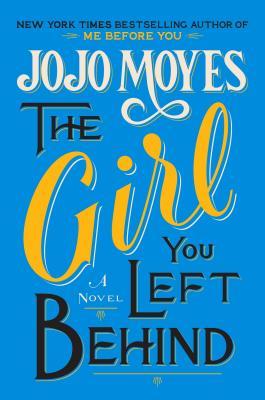
Book Review: The Girl You Left Behind by Jojo Moyes

Title: The Girl You Left Behind
Author: Jojo Moyes
Enjoyment Rating: ****
Source: Library Copy
This book would be rated: PG-13 to R for language, violence, and sex

 The Girl You Left Behind is actually two stories: first, there's Sophie, the wife of artist Edouard LeFevre, she's keeping the family tavern open in the French countryside in 1916 when it is taken over by the Germans. The Kommandant sees the painting of Sophie that Edouard painted before he left for the war, and he becomes entranced by her. Then there's the story of Liv Halston, a young widow whose late husband gave her the portrait of Sophie as a wedding gift. The problem? The LeFevre family, who never heard from Edouard or Sophie again after the war, want the valuable work returned to them.

I loved Jojo Moyes's novel Me Without You, and I was really excited to read this one, too. But the first hundred pages or so (the story of Sophie) weren't as engrossing as I hoped they would be. It seemed to be a fairly standard, depressing story of a young girl who is missing her husband during World War I and is willing to put herself in compromising situations if it might ensure his safety. However, Liv's story is fascinating. Both of the female characters are richly drawn, but I especially liked Liv's story of how the chance she might lose the painting forces her out of her four years of mourning and makes her fight to live again. I'm also pleased to say that there's a rewarding payoff with the Sophie character later in the novel. So be patient with this one-- it will be worth it.

Monday, October 7, 2013

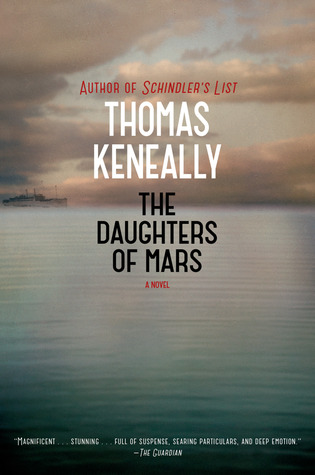
Book Review: The Daughters of Mars by Thomas Keneally

Title: The Daughters of Mars
Author: Thomas Keneally
Enjoyment Rating: ***
Source: Library Copy
This book would be rated: PG-13 for violence, also a little bit of sex, some bad language

Naomi and Sally Durrance are sisters, both nurses, living in Australia at the outbreak of World War I. Their mother has recently died, and the sisters decide independently to join the war effort. They've never been close, and suddenly they're on the same ship, going through the same types of new and unbearably difficult experiences. Their lives in Australia haven't prepared them for the blood and carnage, the shipwrecks, the politics, and the other atrocities of the war. 

Have you ever read a book you know you should like, but you just didn't? That's how I feel about The Daughters of Mars. The three-star rating is because I know in my mind that the book is worthy of at least three stars, but getting through it was agonizing. It felt like eating nasty vegetables, but because it was a library book and I had other library books due back at the same time that I wanted to read, I pushed through. The characters are complex and well-drawn, and the story was epic, so I can't exactly put my finger on what it was that made the book so difficult for me, but I think it was the narrative voice-- there was just a little bit too much emotional reserve and distance in it, which seems to make sense because Naomi and Sally aren't the kind of girls to open their hearts to anyone, but that distance also held me as a reader at bay.

Sunday, October 6, 2013

Book Review: Murder as a Fine Art by David Morrell

Title: Murder as a Fine Art
Author: David Morrell
Enjoyment Rating: *****
Source: Library Copy
This book would be rated: PG-13 or R for violence

Former English majors may know Thomas de Quincey as the author of Confessions of an English Opium-Eater, or as a second-tier romanticist, a friend of Wordsworth and Coleridge. In Murder as a Fine Art, David Morrell draws on one of Thomas de Quincey's lesser-known works, "On Murder as Considered one of the Fine Arts," which examines, in great detail a series of multiple murders that took place in London in the early 1800s. The story, set in 1854, shows what happens when someone tries to recreate and outdo the early murders. de Quincey, who recently moved to London with his daughter, Emily, is immediately considered a suspect, because the details of the original murders are so vividly described in his work. However, the novel quickly shifts gears from a whodunit to a thriller.

I'm a sucker for a good historical thriller, and Murder as a Fine Art definitely fits the bill. Morrell knows his Victorian London. He's able to convey the darkness of the streets at night and the fear people feel as the murderer is out on the loose. He also does a great job developing strong characters in de Quincey, Emily, the murderer, and several detectives (although I thought the implied romance between Emily and one of the detectives was a bit superfluous). The book was a ghoulish pleasure to read from start to finish, although the murders were also very vividly described, which may make it unpalatable for some readers.

Friday, October 4, 2013

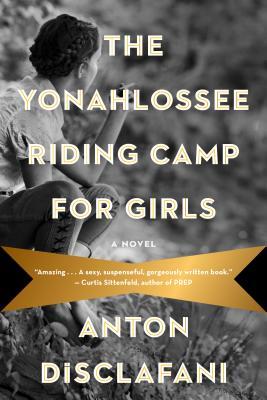
Book Review: The Yonahlosseee Riding Camp for Girls by Anton diSclafani

Title: The Yonahlossee Riding Camp for Girls
Author: Anton diSclafani
Enjoyment Rating: ****
Source: Library Copy
This book would be rated: PG-13 or R for sort of creepy sexual themes

At sixteen, Thea Atwell shows up in the mountains of North Carolina to spend the summer at the Yonahlossee Riding Camp for Girls. The camp is actually a kind of finishing school, and while it's luxurious and her fellow students are friendly, she is fully aware that she's sent there as punishment. As the year (yes, she's there for a year, not the summer as she originally thought) unfolds, the reason for her banishment becomes clear-- her family holds her responsible for a fight between her brother and their cousin that resulted in a serious brain injury for her cousin.

The book is set in the 1930s, and while the main narrative of Thea growing into herself and building relationships with her classmates is very readable and entertaining, what makes this book interesting is Thea's sense of sexuality. It's her budding sexuality that gets her sent to the school in the first place, and she seems to realize that sex is power. However, she's also very young and immature in many ways, and sometimes seems misguided on how to use this sexual power. I was worried that it would be a kind of morality play-- bad girl seduces people and pays; however, the final chapters don't seem to support this. It's the kind of book I wish my friends would read so I'd be able to talk about it with them.

Wednesday, October 2, 2013

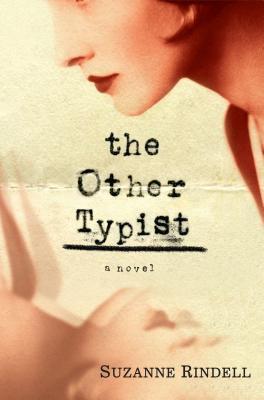
Book review: The Other Typist by Suzanne Rindell

Title: The Other Typist
Author: Suzanne Rindell
Enjoyment Rating: ****
Source: Library Copy
This book would be rated: PG-13 for violence and general darkness

Rose Baker is plain and competent. An orphan raised by nuns, she's good at her job-- working as a typist at a police precinct in New York City in the 1920s, but other than that, she doesn't have a lot going on in her life. Then Odalie joins the typing pool, and Rose's life is turned upside down. Odalie is beautiful, wealthy, and comfortable with men. She also seems to genuinely like Rose, taking her in to live in her hotel suite when things go south at Rose's boardinghouse. Rose loves her new lifestyle-- she wears Odalie's clothes, eats in fancy restaurants, and parties in speakeasies. And life suddenly seems a lot less black and white. This seeps into her work life-- she changes small things in defendants' testimonies when it suits her. And as life gets more and more gray, she starts to see that Odalie isn't who she seemed to be at first.

I read this book the same weekend I saw The Great Gatsby, and while Rindell talks in her afterword about how Gatsby is one of her favorite books, I was struck while reading it how similar the books are. Rose is very much like a female version of Nick Carraway, and Odalie is similar to Gatsby, and in both cases, wealth and power and intrigue seem to corrupt the innocent characters. The book was a really fascinating read, and I read it quickly and thoroughly enjoyed myself.

Tuesday, October 1, 2013

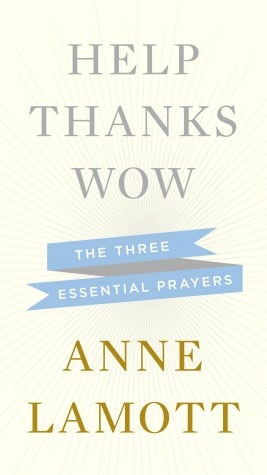
Book Review: Help, Thanks, Wow: by Anne Lamott

Title: Help, Thanks, Wow: Three Essential Prayers
Author: Anne Lamott
Enjoyment Rating: ***
Source: Library Copy
This book would be rated: PG (there may be a few bad words)

I feel like reviewing this book is a little bit unfair, and actually calling this book a book is a little bit unfair. At 112 short pages, this feels more like a pamphlet than a book (and it cracks me up that there is a 30-minute abridged read of the book since I think I read it in less than an hour). I know I'm prejudiced because the book comes in the much-detested "Mitch Albom format" (narrower and shorter than an actual hardback book, but just as expensive at $17.95). That said, once I delved into the book, I actually liked it. Lamott believes that all prayers can be distilled to three essential types: 1) Help, 2) Thanks, and 3) Wow. The first two are pretty self-explanatory, the third is expressing wonder. The book resonated with me in the way a good church talk would, and Lamott provides interesting examples to support her thesis, but after reading her two memoirs, I wanted more meat and more story out of this one. 

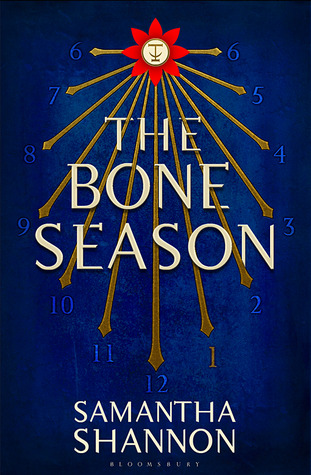
Book Review: The Bone Season by Samantha Shannon

Title: The Bone Season
Author: Samantha Shannon
Enjoyment Rating: ***
Source: Audible
This book would be rated: PG-13 for language, violence and a couple of sexy scenes

Sometimes I find myself really enjoying a book while I'm reading or listening to it, and then in the span of time in between finishing the book and writing the book review, I forget nearly everything about the book, that is a sign to me that it wasn't a great book in the first place.

The Bone Season was getting tons of hype a month or so ago. I must have gotten half a dozen emails from Amazon and Audible and Goodreads about it (yes, I realize they are all the same company), and eventually I found myself suckered into buying it, even though I know that I'm not a huge fan of dystopian novels and I'm also not a huge fan of trilogies.

Paige Mahoney is living in London in 2059. Her father thinks she works at an oxygen bar in the city, but she's really a voyant (someone with supernatural powers), and she works as part of an underground syndicate with other voyants. She's able to enter into the dreams and minds of other people, and she accidentally uses this power to kill several people on a train. This blows her cover and she's rounded up and shipped off to Oxford, a city where voyants can live out in the open, but they are controlled by Rephaim, an alien species.

Paige, being a feisty girl, has no patience for her situation and wants to escape. She's put under the control of Warden, the fiance of the really creepy woman in charge of the whole place. Warden seems tough and cold, but eventually Paige learns that he also wants to be free of the rules of the place. But can a small group of fighters go up against all of the Rephaim?

 I felt that Paige was a fairly flat character-- she's a stock feisty girl, and Warden is pretty much exactly like Edward Cullen or Matthew Clairmont from Discovery of Witches. I didn't want them to get together, but it felt inevitable that they would.  And reading about fighting bores me, but overall the book is engaging and easy to listen to. But that doesn't mean that I'm on board with books two and three in the series.

Book Review: Operating Instructions by Anne Lamott

Title: Operating Instructions: A Journal of My Son's First Year
Author: Anne Lamott
Enjoyment Rating: ****
Source: Library Copy
This book would be rated: PG-13 for language

After reading Some Assembly Required, a journal of Anne Lamott's first year as a grandmother, I knew I needed to go back and read the source on which it was based, Operating Instructions, which is a journal of her first year as a mother.  The books are similar in many ways-- in both cases Lamott is completely wrapped up in this baby in her life, but she also manages to weave in the non-baby stories of that year, all in her characteristic confessional, self-deprecating style.

When I was a first-time mom, at 25, I thought that I knew everything. I'd read a whole bunch of books, and I'd wanted to be a mom ever since I could remember, and it wasn't until Bryce was actually here that I realized that it was harder than I thought it would be. Lamott, on the other hand, had a decade's worth of experience on me, and had already attained a measure of success in her life (unlike me), yet she seemed to approach motherhood with a sense of trepidation. Maybe it's because of that that she was able to see every fantastic moment with a bit of wonder. I expected all moments to be fantastic and was frustrated when they weren't.

I'm also happy to know that I'm not the only mom who has said bad words to her baby, thought he was evil and out to ruin my life, or wanted to escape completely some times. I think this would be a great book for all new moms to read, but it resonated equally well with me. I just wish she'd written about Sam's toddler years. I need to find someone else who is suffering through those years with as much humor and intelligence as Lamott shows here.

Tuesday, September 10, 2013

Sibling rivalry, six months in

Then
Now


For most of the last year, I've had an idea stewing in my brain. I'd write a memoir about this whole experience of adopting virtual twins. Ed is rolling his eyes right now and internally accusing me of adopting for material to write a book, but adding two toddlers to a family is something no sane person would do for the sake of research. You can take that however you want. But I figured that as long as I wasn't rewriting either of the novels I wrote in grad school or starting some new fiction project, I might as well rework some of my essays and blog posts and use them as the starting ground for a memoir (of course, this hasn't happened, because every time I open my laptop during the day someone starts climbing on me, and right now I'm writing while two babies maintain eye contact with me from their beds in separate rooms). Anyway, I even had a name for this theoretical memoir all picked out-- Are They Twins?

The funny thing is, after six months home, no one has asked me if they're twins, not even once. Most conversations with well-meaning, nosy strangers go something like this:

"Are they adopted?"
"Yes."
"How far apart in age are they?"
"Six months."
"Are they really brother and sister?"
To which I answer, "They are now," or "No," or "You do the math," or "Who knows, maybe their dad got around," depending on the day and how snarky I feel.

I really expected that people would automatically assume they were twins. I often dress them in coordinating outfits, and think they look enough alike that they could be siblings. Add in the whole "Chinese among white people" thing and I figured it would be a natural expectation.

But they don't seem like twins. For one thing, Rose is three inches taller and six pounds heavier than Eli. When we adopted her, she shot up from 13 to 30 pounds in a year, and I assumed that Eli would do the same thing. But he weighed 23 pounds when we adopted him, and he's tipping the scales at 25 1/2 as of today, which isn't a huge weight gain in nearly six months.

Even more than their physical size, Rose outweighs him in personality. Before we had her, based solely on stereotypes, I imagined that the daughter we would adopt from China would be petite and reserved, possibly a little bit shy and retiring. Instead we got a big girl with an even bigger personality. She's so loud. She screams whenever something doesn't meet with her immediate approval. Even when she couldn't communicate her wants with words, she didn't have much problem making them known. She jumps and hits and runs and barrels through life with an energy that can be exhausting. From the moment she met Eli, she's been unsure whether he was friend or foe. These days, he's usually a friend, but she can break out the claws in a flash if she ever feels threatened.

There's something I hate about this way of characterizing my own kids. One of Rose's greatest strengths is that she's a fighter. It's probably the quality that allowed her to survive on the cold April night when she was abandoned, and it's certainly the quality that got her through the next eleven months in the orphanage. It will undoubtedly serve her well later in life, But she doesn't need to fight in the here and now, and sometimes I think she doesn't know how to turn it off. I know that when she's in preschool, I'm going to get calls from the teacher about how she pushes other kids on the playground or butts to the head of the line. I do my best to put her in time outs and time ins, to give her plenty of one-on-one love, and praise her strengths, but I know that the fighter will always be there.

My dad grew up in a house of four boys. He was the oldest, also known as "the smart one." There was an "athletic one," and a "funny one," and another one (I can't remember how he was characterized). And even though they had parents who loved them and all grew up to be good fathers and productive members of society, I know it bugged my dad and his brothers that they were circumscribed and reduced to a single dimension. I don't want to do that to Rose and Eli.

But it would be denying the reality of the dynamic not to admit that Rose has been the aggressor during the last six months. Six months from now, the story might be entirely different. I think a lot of it has to do with the fact that she is physically larger, that Eli couldn't walk when we got him, and that she felt threatened when her position was usurped. Then Eli spent five of the last six months in a series of nine casts, which only increased the imbalance of power. It's been a great blessing to all of us that he's been so mild and easygoing about his state (whiny, yes, at times, but generally, very easygoing). I can barely get Rose into her car seat, I couldn't imagine trying to strap her into a Ponseti brace for eighteen hours a day. I love that he is so sweet, so snuggly. Rose has been home for a year and a half, and she still doesn't voluntarily give hugs and kisses, but Eli loves to kiss, and one of his first phrases was "lub you." They just seem so opposite in so many ways, and sometimes I wish Eli would stand up and clock her hard on the head to let her know that she can't take advantage of him. Then I feel guilty for feeling that way, and for stealing her opportunity for babyhood by adding him to our family.

Still, they are definitely more friends than foes. Last night at bedtime, Rose was angry (as usual) at being put in bed. She was lying there, screaming, big, fat tears running down her red cheeks. It was time to put Eli to bed too, but he stood next to her, stroking her head, trying to help her feel better. As I sit here typing this, she's calling out "bah," from her bedroom, which he returns with a "bah," from his bedroom, and then they both giggle and do it again. When she wakes up in the morning, the first thing she wants to do is go find "Ly." This sometimes backfires-- like today when they'd both been down for their naps for 30 minutes and I was just finishing up some Segullah emails, and heard crying from upstairs. I came up to find her in his crib with him. She must have had a hard time falling asleep on her own and went to find a little companionship, waking him from a deep sleep. (And you didn't want to be anywhere near my house from 3-6pm tonight because they were both completely evil). I love that they are now great playmates for each other, at least until I turn my back.

At two, Rose is feisty and Eli is gentle, and I recognize that these characterizations are in large part in opposition to each other. If they weren't feisty and gentle, maybe they would be the early bird and the night owl, or the smart one and the dumb one (I'm so glad I don't think of them as smart and dumb). I don't think admitting that at this stage in their lives they exhibit these qualities is necessarily a bad thing, but I also hope that I'm not so rigid in my thinking that I won't allow them to redefine themselves. Maybe some day they will be mistaken for twins, and maybe they never will, but one thing is for sure-- they are brother and sister. Really brother and sister. Because over the last year and a half, the thing I've learned again and again is that it isn't blood that makes a family. It's living with, and loving, and yes, sometimes hating on each other. And they've had plenty of that over the last six months, with a whole lot of togetherness ahead of them.
Sunday, September 1, 2013

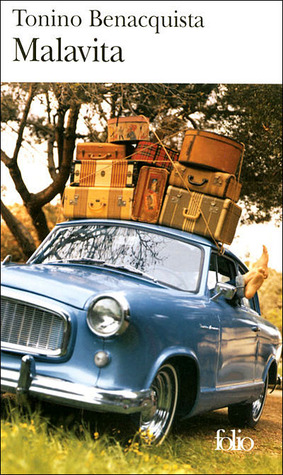
Book Review: Malavita by Tonino Benacquista

Title: Malavita
Author: Tonino Benacquista
Enjoyment Rating: **
Source: Library Copy
This book would be rated: PG-13 or R for language, violence

When Fred Blake and his family move to a small town in Normandy, no one in town is prepared for what they're getting. Yes, they're getting American expatriates, but Fred is not the writer he claims to be. Oh, he writes, but instead of writing about the WWII invasions, he's really writing his memoirs about his times as a mob boss. He was such a successful mob boss, in fact, that when he and his family entered witness protection he had a sixteen million dollar bounty on his head and became the only person ever to be relocated internationally.

But instead of being grateful for his family life and his relocation, Fred (and the rest of his family) do whatever they can to thwart the efforts of their protectors. And because he's spending so much time writing down his story, it's almost irresistible for him to start talking about it too. And pretty soon, the mob comes knocking.

If you like books or films that treat violence lightly (think Pulp Fiction or Kill Bill) than you would probably enjoy Malavita. That is not the kind of story I like, and I also felt that it took a long time for Benacquista to get beyond laying the backstory and into the actual events of the novel. The novel is being made into a film, and I think I'll pass. I can already imagine the carnage on the streets of Normandy.